Will Robie and Dan Robie Reconcile
The GuiltyWill Robie and Dan Robie Reconcile is a family reckoning in which a history of wartime trauma and inherited cruelty is spoken aloud rather than passed over in silence. Dan explains how his father’s experience in World War II shaped the household in which he grew up, then admits that he repeated aspects of that harm with Will. Will’s return to help him and his demand for the truth make possible a different ending: not a recovery of the years they lost, but a mutual decision to move forward together.
The Photograph and the Family History
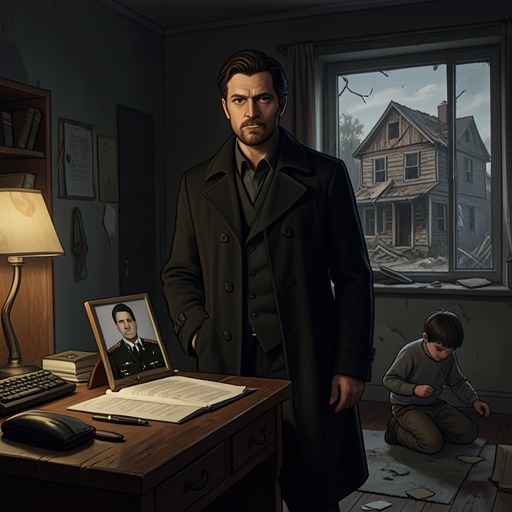
The conversation turns on a photograph Dan takes from his wallet. It shows Adam Robie, Will’s grandfather, in a United States Marine uniform: a young man with a granite jaw and a flinty expression. For Will, the image first presents an unfamiliar ancestor. Dan uses it to introduce the history behind the face and to explain why the man he remembers as a father was also a survivor of war.
Dan recounts that Adam fought across the Pacific, naming Guadalcanal, Kwajalein, Guam, Iwo Jima, and Okinawa. His company suffered a seventy-percent mortality rate, and Adam received many of the medals awarded to combat soldiers. Yet after returning home, he put those medals in a box and did not discuss the war. Dan says he learned the extent of his father’s actions from other people, not from Adam himself. The photograph therefore stands beside a conspicuous absence: military honors survived, but the story of what they represented did not become a family conversation.
Dan describes the life Adam had expected before the war: he was a farm boy from Arkansas who wanted to play baseball for the St. Louis Cardinals and marry his childhood sweetheart. Neither hope came true. After she married someone else, Adam married a woman he did not love, and Dan was born into a life shaped by choices made in the aftermath of war. The account does not present these losses as a complete explanation for Adam’s conduct; it shows the distance between the life he imagined and the life he returned to inhabit.
War’s Aftermath and Repeated Harm
Dan explains that PTSD was not a term available to describe what Adam endured at the time. In his account, the men who fought in World War II were expected to return to civilian life as if years of war could be set aside. Adam could not simply reset. Dan recalls that his father seemed to mistake him for an enemy, attacking him with his fists and words and subjecting him to cruel mind games. On one occasion, Adam called him by a Japanese name. Dan describes the episode as evidence that his father was reliving the war, and remembers a once-strong man reduced by an experience he could neither discuss nor leave behind.
Dan also places his own experience against that of his father’s generation. He says returning veterans such as himself did not receive the same public welcome as the World War II soldiers; instead, he remembers hatred, disgust, and indifference. He recalls the disheartening contrast between years spent in jungles and coming home to little recognition. This comparison broadens the scene beyond one household: the war changed both Adam and Dan, though the circumstances and public responses surrounding their returns differed.
The most difficult turn comes when Dan connects that history to his treatment of Will. He acknowledges that while yelling at or roughing up his son, he could picture his own father doing the same to him. One part of him insisted he would never behave that way toward his child, while another part acted it out. Dan explicitly recognizes that the explanation does not make light of what he did. He also distinguishes his conduct from that of most veterans, who, he says, do not mistreat their children in this way, and calls himself weak rather than presenting the inheritance of trauma as an excuse.
Dan’s Confession and Will’s Return
Dan’s account becomes more personal as he remembers Will’s standing in their community. Will had been a popular student, a sports star, and a good person who helped others without acting superior. Dan says he had every reason to be proud of him, and that part of him was. But he also admits to a competing feeling: jealousy that Will had the life Dan wanted and never had. Dan can only tentatively explain that he may have tried to ruin that life and make it more like his own; he does not claim clinical insight or certainty about his motives.
In naming that jealousy, Dan acknowledges both what he did and what it cost. He says Will had every right to hate him and recognizes the years they might have spent as a family as wasted. The confession does not undo those years or demand that Will excuse him. Instead, it makes the lost relationship part of the truth Dan had withheld, and lets Will hear his father take responsibility for the harm rather than leave it unexplained.
Will asks why Dan is telling him all this now. Dan points to actions as well as words: Will came back to help him and nearly got killed doing so. He also recalls that, on returning, Will asked for one thing—the truth. Dan treats those two facts as the reason the conversation has become necessary. His decision to speak is thus tied not to a sudden claim that the past has been repaired, but to Will’s demonstrated care and explicit request for honesty.
An Apology and a Shared Future
After the confession, Will urges his father to look forward rather than remain fixed on the past. When Dan wonders what he has left, Will names Tyler Robie and then includes himself. Dan grips Will’s hand and apologizes; Will answers that both of them have things to regret, but that they need to move on together. The exchange shifts the scene from an account of inherited damage to a modest, shared commitment. It does not promise that reconciliation will erase the past; it establishes that neither man has to face what comes next alone.
Will puts his good arm around Dan’s shoulders, and the two men hold on to one another. Will’s eyes fill as well, marked as another first. Jessica Reel, who has encouraged his response, wipes at her own eyes and then looks away to give father and son privacy. Her withdrawal keeps the final moment with the two Robies: the reconciliation is witnessed, but not intruded upon.
Narrative Significance
The scene makes family history newly legible through a photograph, a withheld account, and an admission of repeated behavior. Adam’s silence about the war and Dan’s delayed explanation have left Will with the consequences but not the context. Dan’s testimony supplies that context while preserving his responsibility: the past helps explain the pattern, but he does not claim it absolves him. In that distinction, the scene treats telling the truth as a necessary act of accountability rather than a substitute for it.
The emotional change is measured rather than absolute. The years Will and Dan lost remain lost, and the conversation offers no evidence that every consequence of their estrangement has disappeared. What changes is the basis on which they can relate: Dan names his part in the harm, Will accepts a future that includes his father, and both men turn from regret toward action together. Jessica Reel’s final gesture reinforces the scene’s quiet scale. The resolution belongs not to a public declaration but to a hand held, an apology made, and a son’s arm around his father’s shoulders.